Preneurs.ai
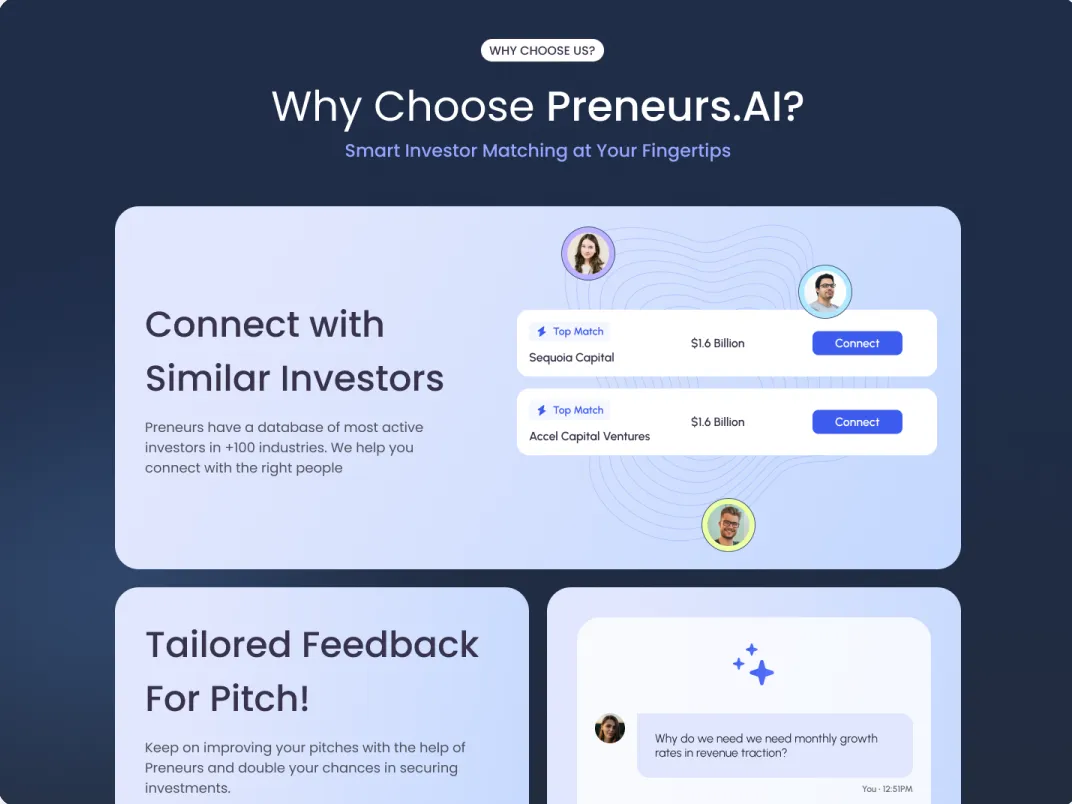
An AI fundraising co-pilot for founders, built around the activation problem: founders don't understand the value of pitch feedback until they see it.
- DXWand
- Fractional CPO
- Jul — Nov 2024
Context
Preneurs.ai was DXWand’s bet on a structural problem in early-stage fundraising: first-time founders are routinely underprepared, investors are routinely overwhelmed by low-signal inbound, and neither side has tools that close the gap. The product would be a two-sided AI co-pilot — pitch deck analysis and investor matching on one side, candidate qualification on the other — built for the MENA ecosystem with global ambitions.
I joined as fractional CPO to take it from concept through shipped MVP to paying founders.
Research and discovery
The engagement opened with two parallel interview streams — founders and investors — run under explicit discovery discipline. The guidelines mattered: don’t pitch the product at the start of the call, don’t frame the problem at the start of the call, ask about facts (how long did fundraising take you) not feelings (was it time-consuming), and let users surface their own pain points before testing ours.
Ten plus founder interviews, plus investor conversations across the MENA VC ecosystem, surfaced the central finding: founders described their top pain as “finding the right investors” — but when shown a pitch deck evaluation report mid-interview, their interest visibly shifted. The aha wasn’t matching. It was being told something specific and useful about their actual deck.
That reframed the product. Founders couldn’t perceive the value of AI-driven feedback from a description; they had to see the report before they understood what was being offered. Stated need (investor matching) was real but downstream of an unstated need (specific, grounded feedback that would build trust in the product itself).
The investor interviews surfaced the matching problem from the other side — VCs see hundreds of decks, only a fraction match their actual focus, and existing tools don’t capture the nuance of what each investor actually optimizes for. That observation drove the investor archetype taxonomy that anchors the matching system.
Approach — two design calls from the research
The research produced two product decisions that shaped everything that followed.
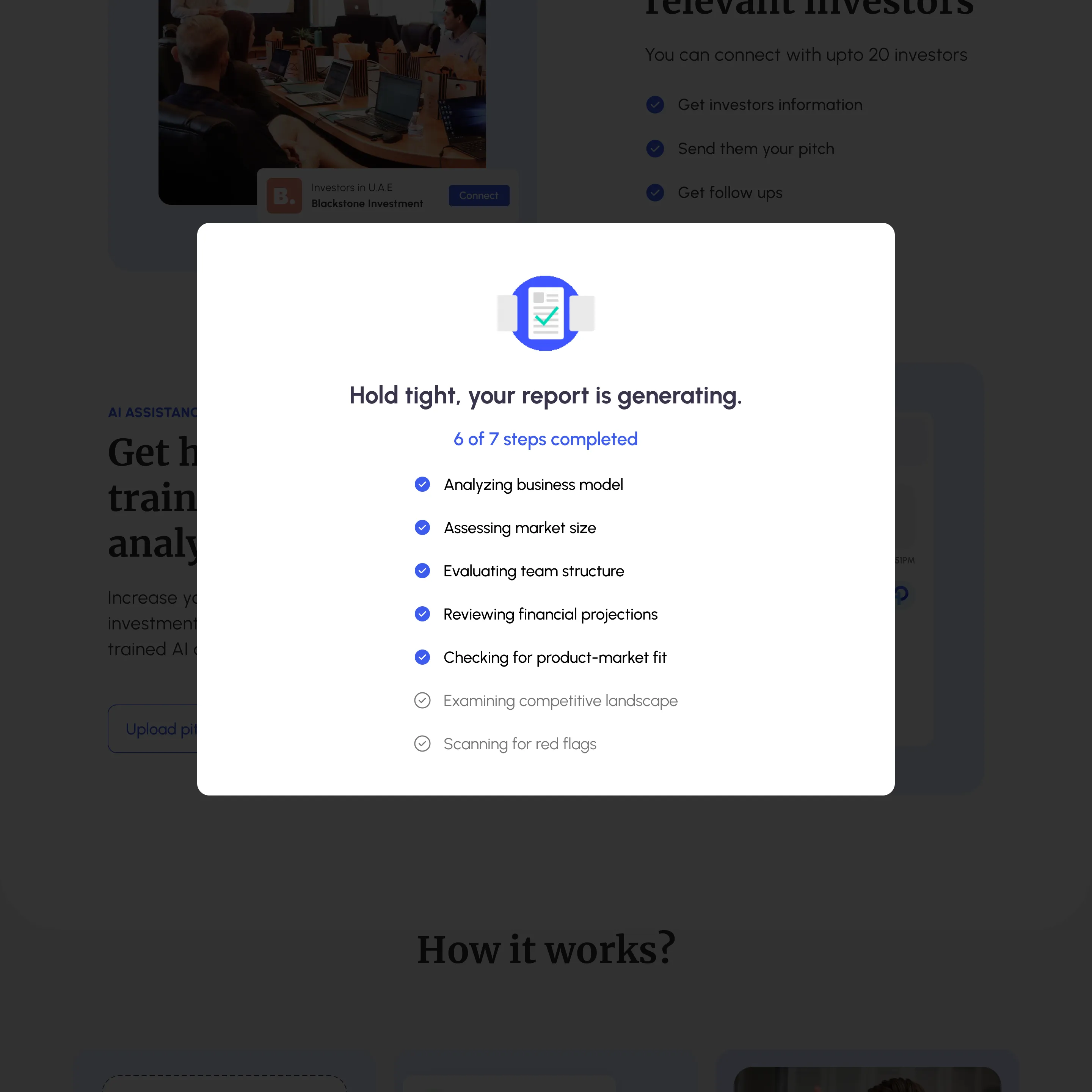
Move the value moment ahead of the commitment ask. Most AI products front-load signup before output. The interview finding inverted that for Preneurs.ai. The landing page accepts a pitch deck upload directly. The user sees a partial evaluation report before any login wall hits. The full report and investor matching sit behind authentication — but the activation moment, the proof that the AI does something specific and useful, is free and immediate.
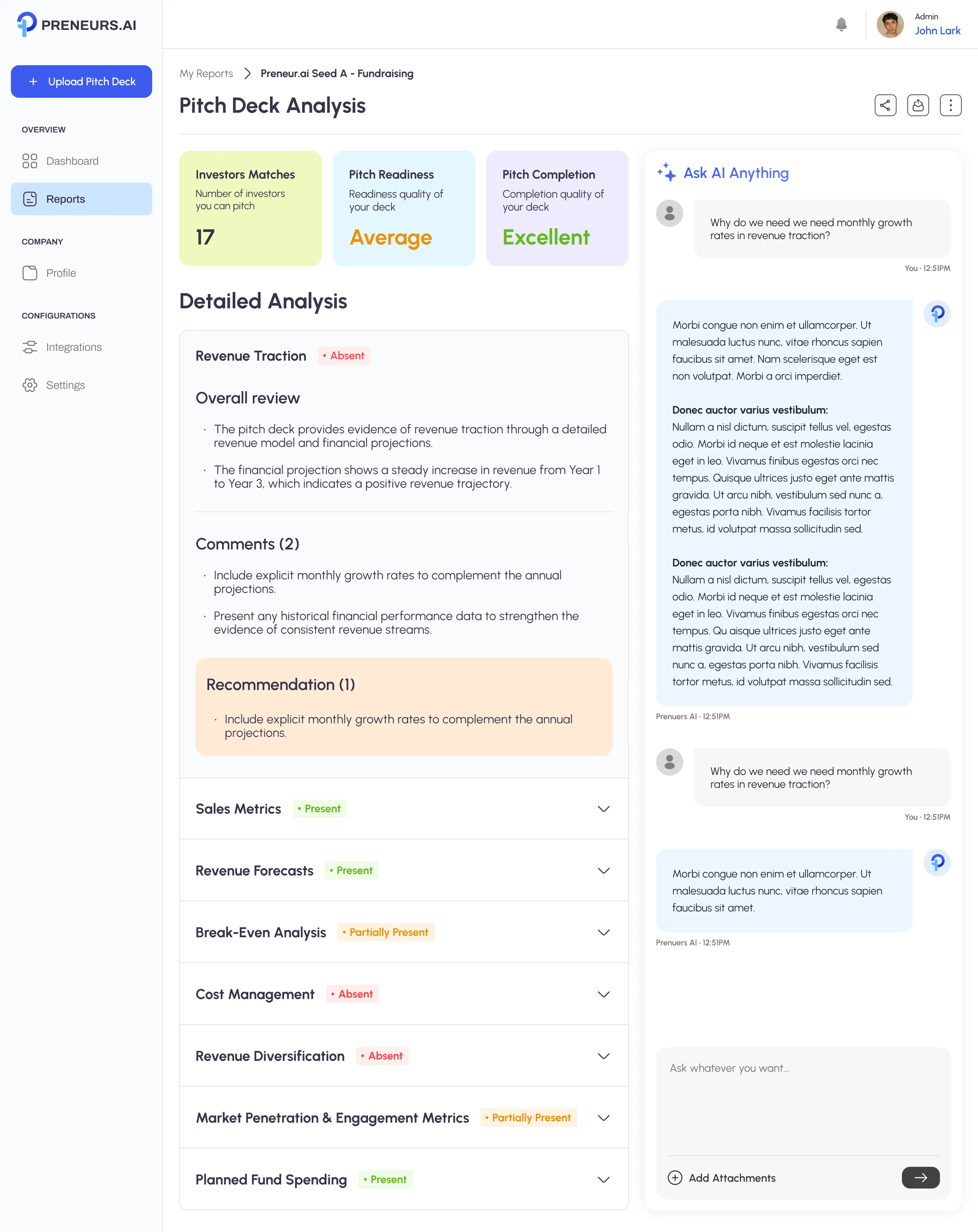
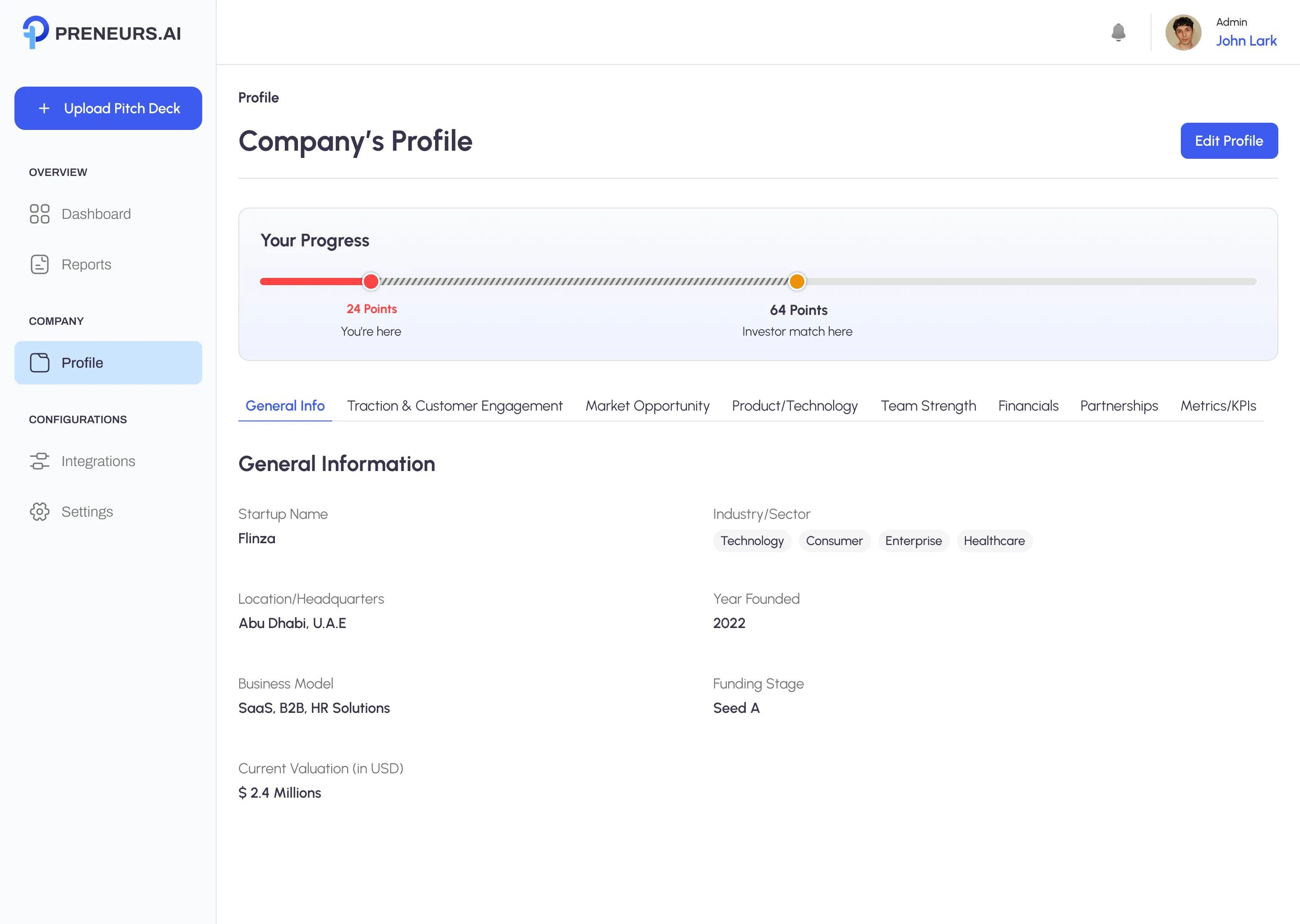
Score on three legible axes, with stage-aware difficulty. The matching system architecture handles the underlying complexity but surfaces three numbers the founder can act on: Startup Readiness (traction, team, market, business model, financials, MVP — weighted differently for Pre-seed, Seed, and Series A), Pitch Deck Completion (whether each required section is present and substantive for the targeted stage), and Investor Match (against eight investor archetypes capturing what each fund actually optimizes for — founder oriented, financial oriented, product oriented, sector oriented, geo oriented, stage oriented, market oriented, scalability oriented).
A specific design decision worth surfacing: the team kept passing thresholds constant (70%) across stages and increased scoring difficulty at higher stages instead. A pitch deck submitted as Pre-seed gets graded against Pre-seed expectations; the same deck submitted as Series A gets graded against Series A expectations and almost certainly fails. The decision keeps the user-facing mental model simple (one passing line) while letting the AI apply calibrated rigor underneath.
Solution
Outcome
Shipped to paying founders. The activation pattern (deck drop on landing → partial report → login → full evaluation and matching) held — founders consistently engaged with the report once they saw it, and the conversion challenge that had defined the early product problem dissolved once the value moment moved ahead of the signup wall. Continued development under the DXWand product team after the engagement.
Reflection
Two things from this engagement are carrying forward.
First, the activation problem in AI products is now its own design domain. Most AI tools still front-load signup, then ask the user to type a prompt, then deliver value. That sequence costs activation. Preneurs.ai’s inversion — show the AI’s output before asking for commitment — is becoming the dominant pattern across consumer AI (Spotify, Loom, Notion AI all do versions of this), but it’s unevenly applied in B2B and B2-prosumer tools. For products where the AI’s output is the value, the activation question isn’t “how good is the AI” but “how fast can we show the user what it does.”
Second, when stated user needs and product-market fit drivers diverge, listen to the second one. Founders said they wanted investor matching. They engaged when shown pitch deck evaluation. The right product call wasn’t to optimize matching — it was to treat evaluation as the entry point, build trust through the report, and use that trust to make matching meaningful. Stated needs are where the conversation starts; product-market fit drivers are where the design has to actually land.
Kawader →
Designing AI-enabled flows for Qatar's national workforce platform — and making the case for agentic forms over chat.