Kawader
Designing AI-enabled flows for Qatar's national workforce platform — and making the case for agentic forms over chat.
- Scale AI × MCIT & CGB
- Lead Product Designer (International Public Sector)
- May 2025 — Feb 2026
Context
Kawader is Qatar’s national workforce platform — long-established and running at scale, the government’s public-facing system for connecting job seekers to public and private-sector roles. The 2025 brief was to redevelop key flows using AI.
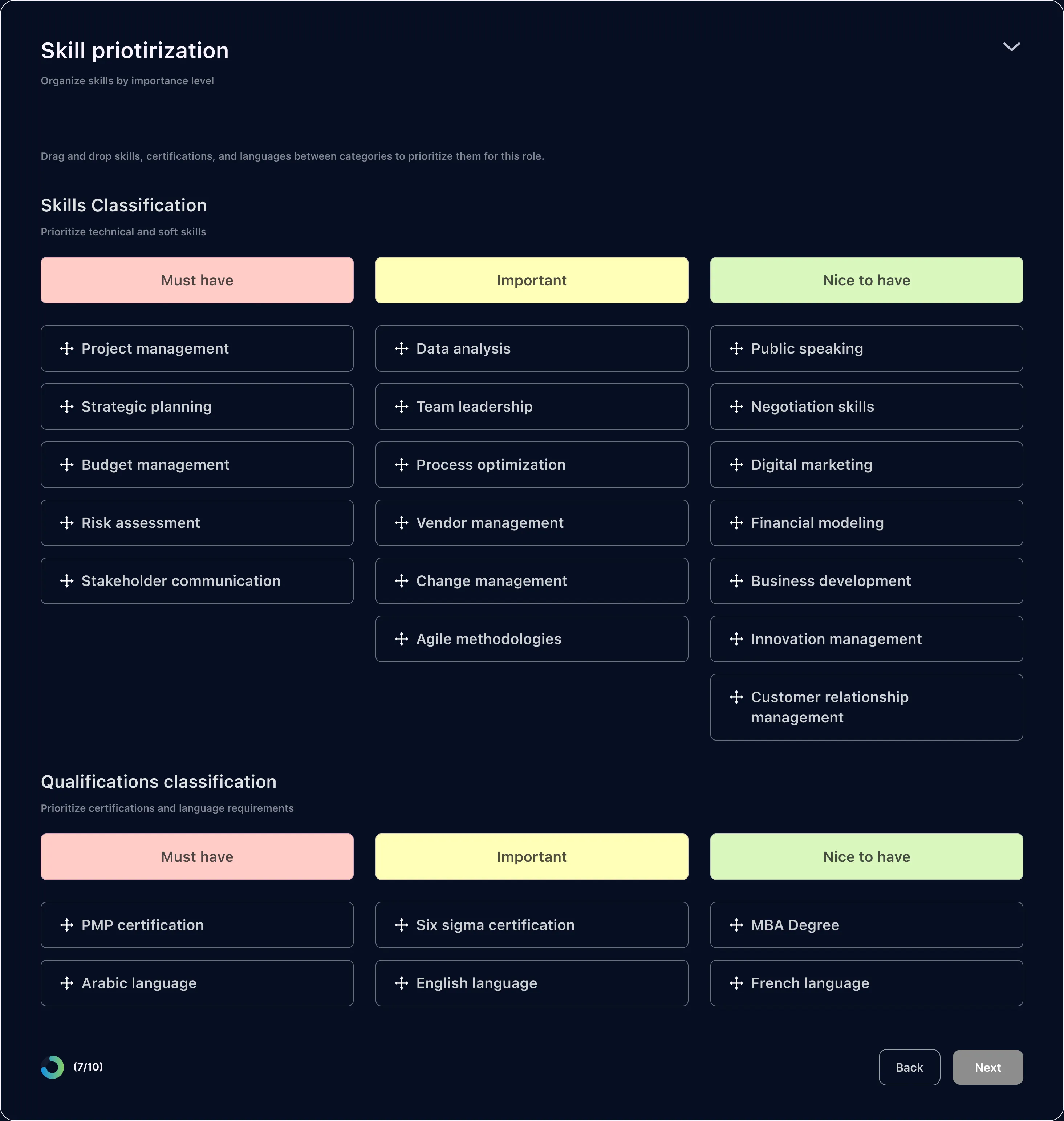
Within Scale AI’s International Public Sector team — which delivers applied AI for governments — I led design on three modules: Profile creation for applicants, Job posting for employers, and Matching, where the two converge — the surface employers use to review candidates surfaced for their roles.
Research and discovery
The team’s first instinct was that AI on Kawader would mean a chatbot. That argument didn’t get won in one round.
Profile creation shipped first as a chatbot, then iterated to in-chat forms, then stayed there. Job posting went through the same arc and pushed further — to agentic forms. What’s sometimes presented as a single pivot moment was a year of accumulated evidence: research before each module, field-level analysis, prototypes that didn’t quite work, and stakeholder readings that shifted as the data did.
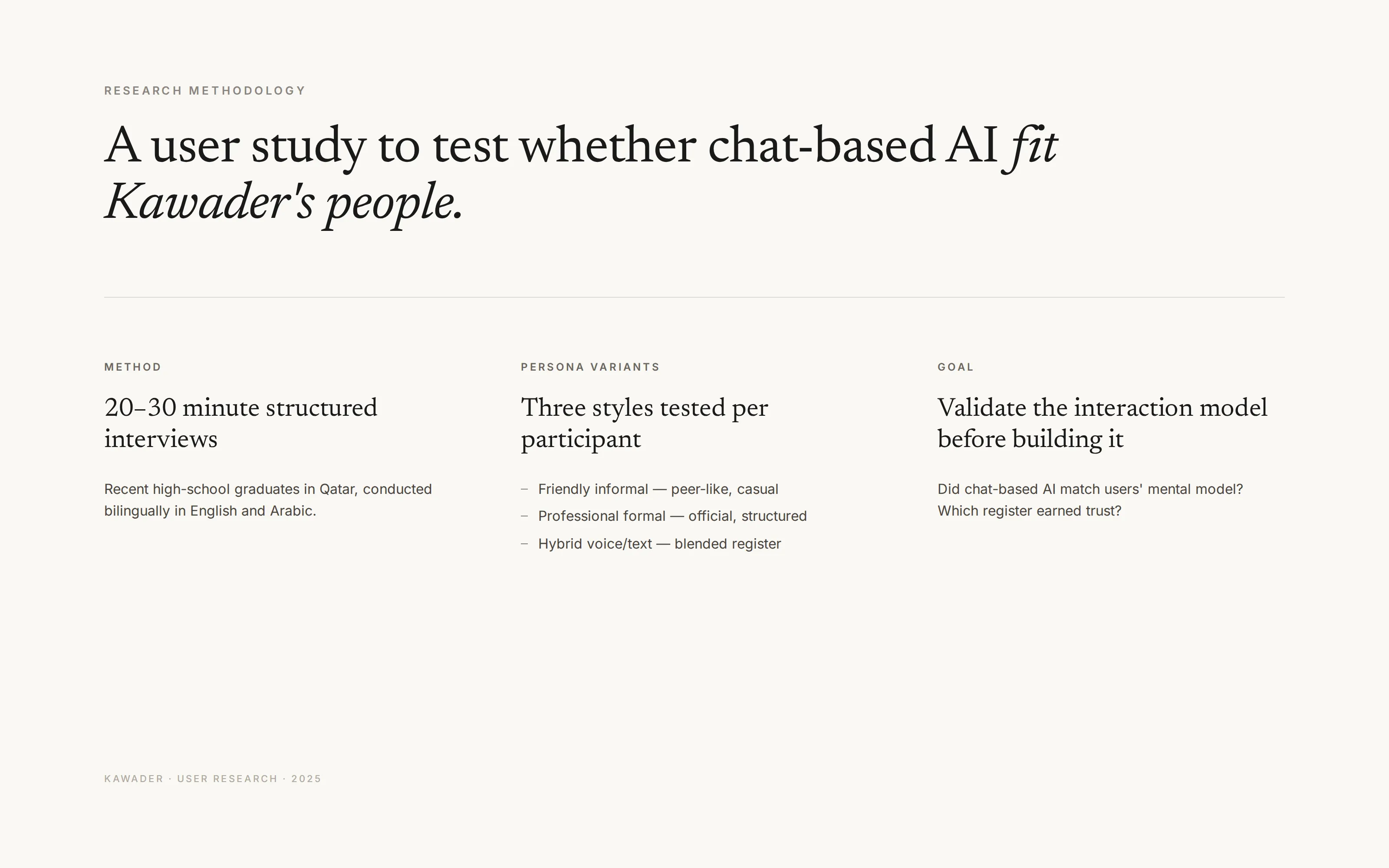
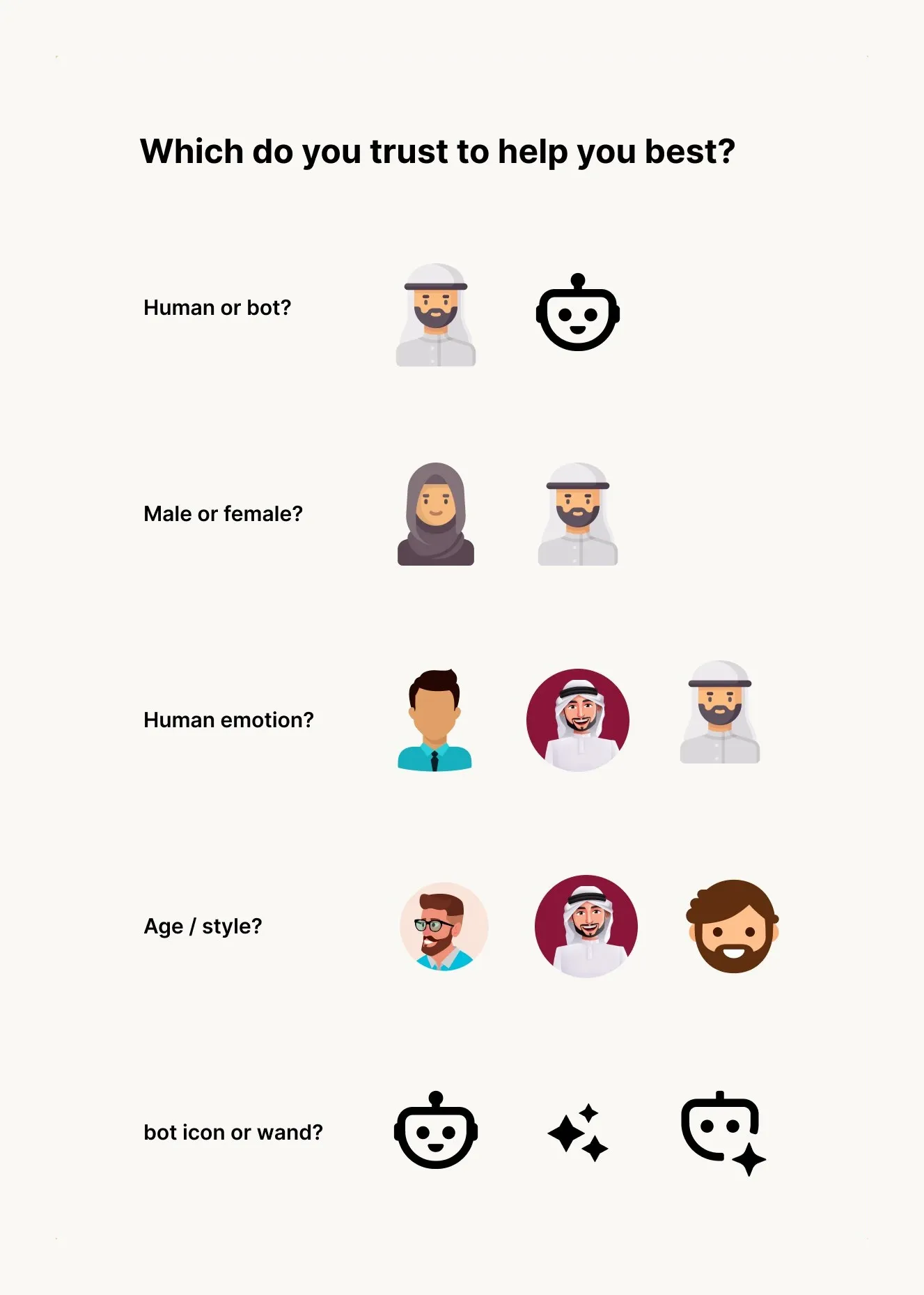
The methodology: five 20–30 minute structured interviews with recent high-school graduates in Qatar, conducted in Arabic. Three chatbot personas tested with each participant — friendly informal, professional formal, and a hybrid voice/text assistant. The personas were paired with a branching identity probe: who would you trust to help you, a human or a bot? If human, what kind? If bot, what visual register? The branching kept following the user’s preferences to find the form chat would need to take to earn their trust.
The qualitative round wasn’t the only evidence. The Social and Economic Survey Research Institute (SESRI) at Qatar University had already published representative survey data on Qatari youth attitudes toward Kawader, and the picture was sharper than mood. 74% of young Qataris had never used the platform. Among those who had, only 48% were satisfied. 62% complained of slow responses, 36% saw rejections without clear reason, and 91% cited English-language requirements as a barrier. The data named what the qualitative interviews would later confirm in users’ own words.
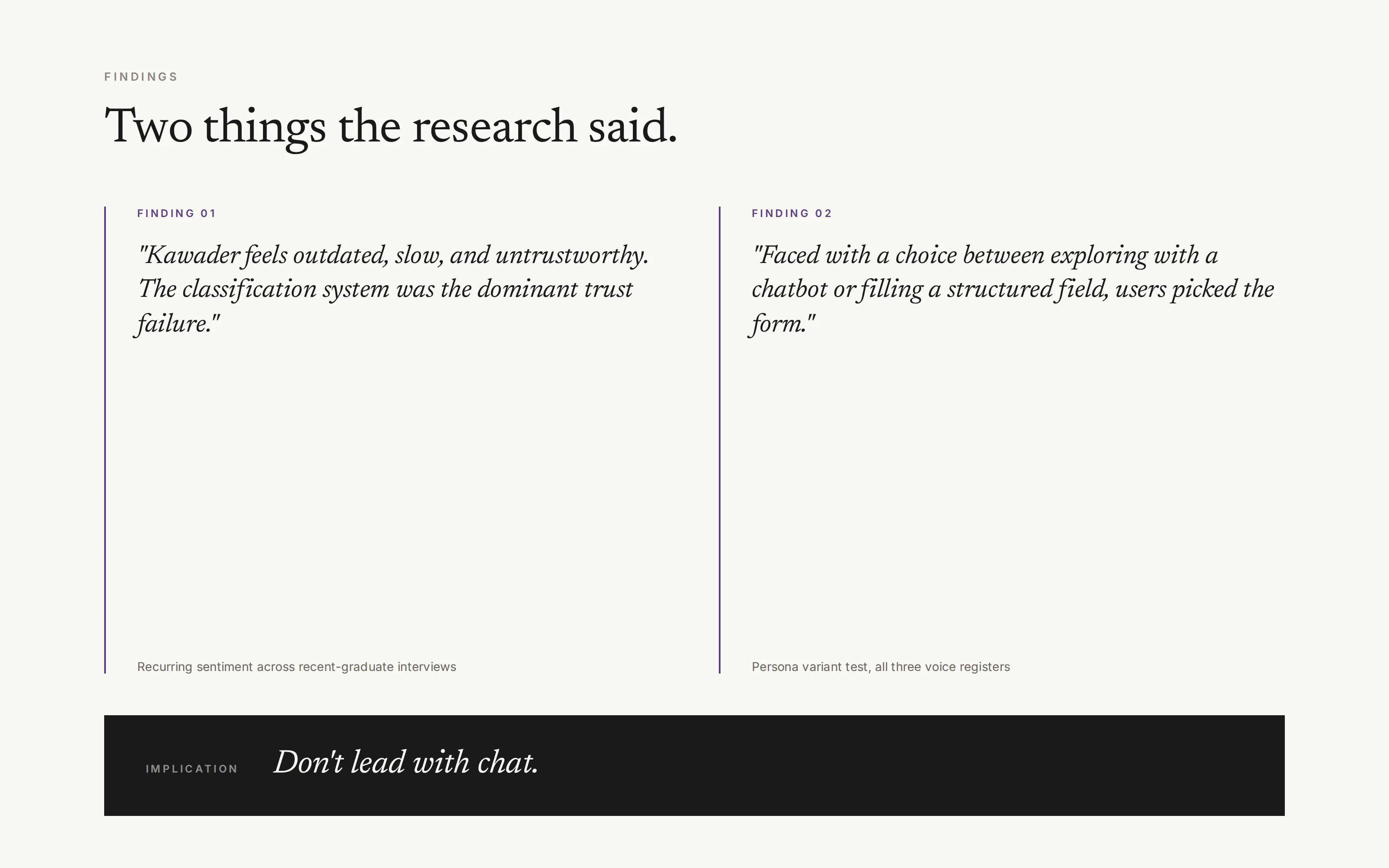
Two findings from the qualitative round shaped the rest of the work. First, sentiment toward Kawader was uniformly negative — users described it as outdated, slow, and untrustworthy, with the classification system (red/yellow/green lists with no transparency on assignment) as the dominant trust failure. Second, in persona testing, users consistently preferred clarity over conversation. Faced with a choice between exploring a question with a chatbot or filling out a structured field, they picked the form.
User research was the first push against chat. A second came later, from a field-level analysis of the data Kawader was actually collecting.
Problem framing
The interviews and survey data converged on three design problems, each in a different module.
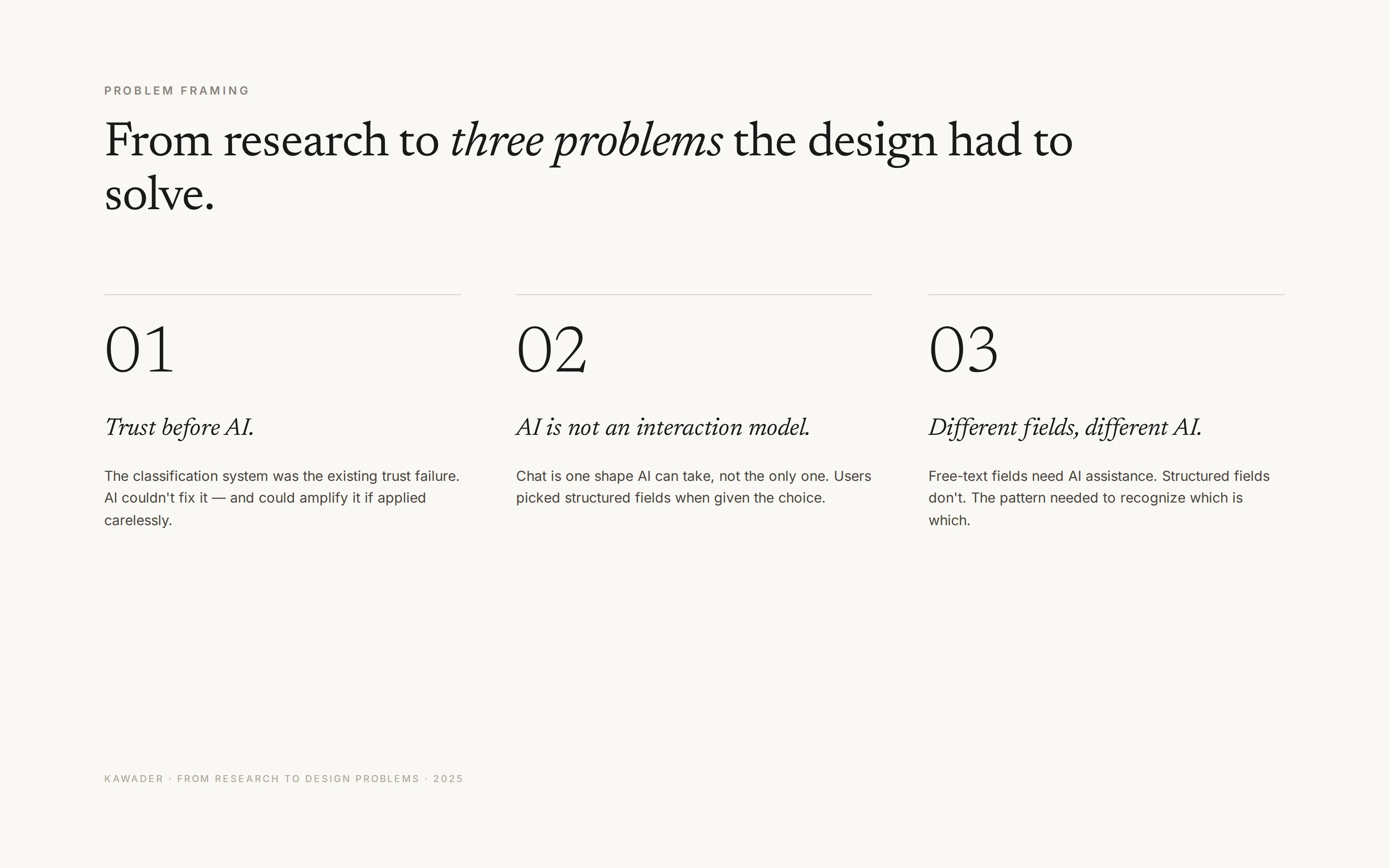
Each problem implied a different kind of solution. Profile creation needed to reduce manual input. Job posting needed structure with targeted AI assistance. Matching needed explainability — why a candidate was surfaced. Treating these as one design problem, with one chatbot, was the original mistake.
Approach
The interaction model evolved in three steps.
Chat. The default assumption — let users describe themselves, the system extracts.
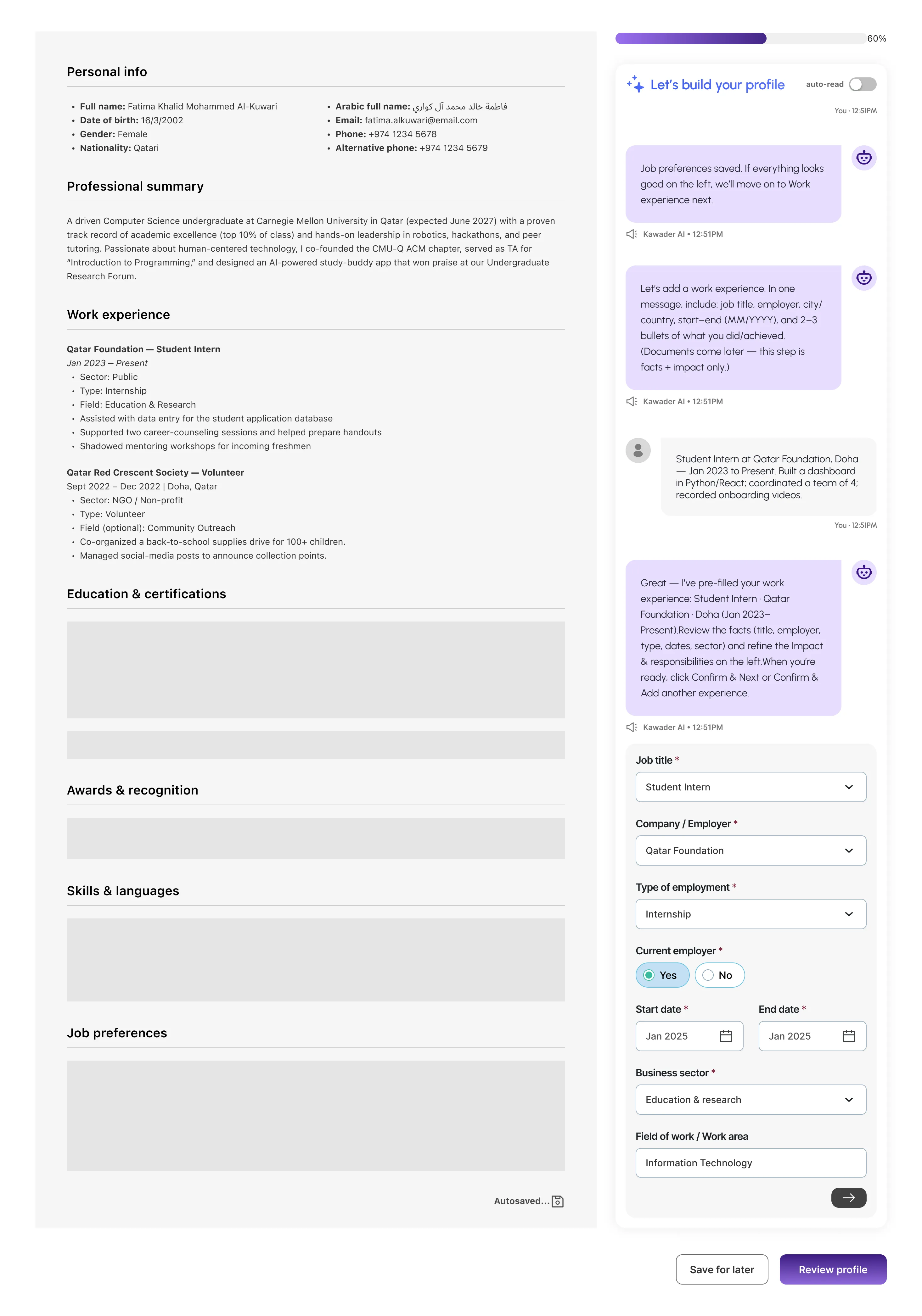
In-chat forms. The first compromise: keep the chat shell, render factual fields as inline forms. Better, but the wrapper still created the trust ambiguity the research had flagged.
Agentic forms. To justify moving past the compromise, I ran a field-level analysis of every input in the Job posting flow. Most fields were factual or low-AI-benefit. In-chat forms were working half the time and adding friction the rest. Our PM named the pattern; I designed the interaction model and the first UI — forms as the surface, AI alongside as guidance, chat only where it has a discrete job.
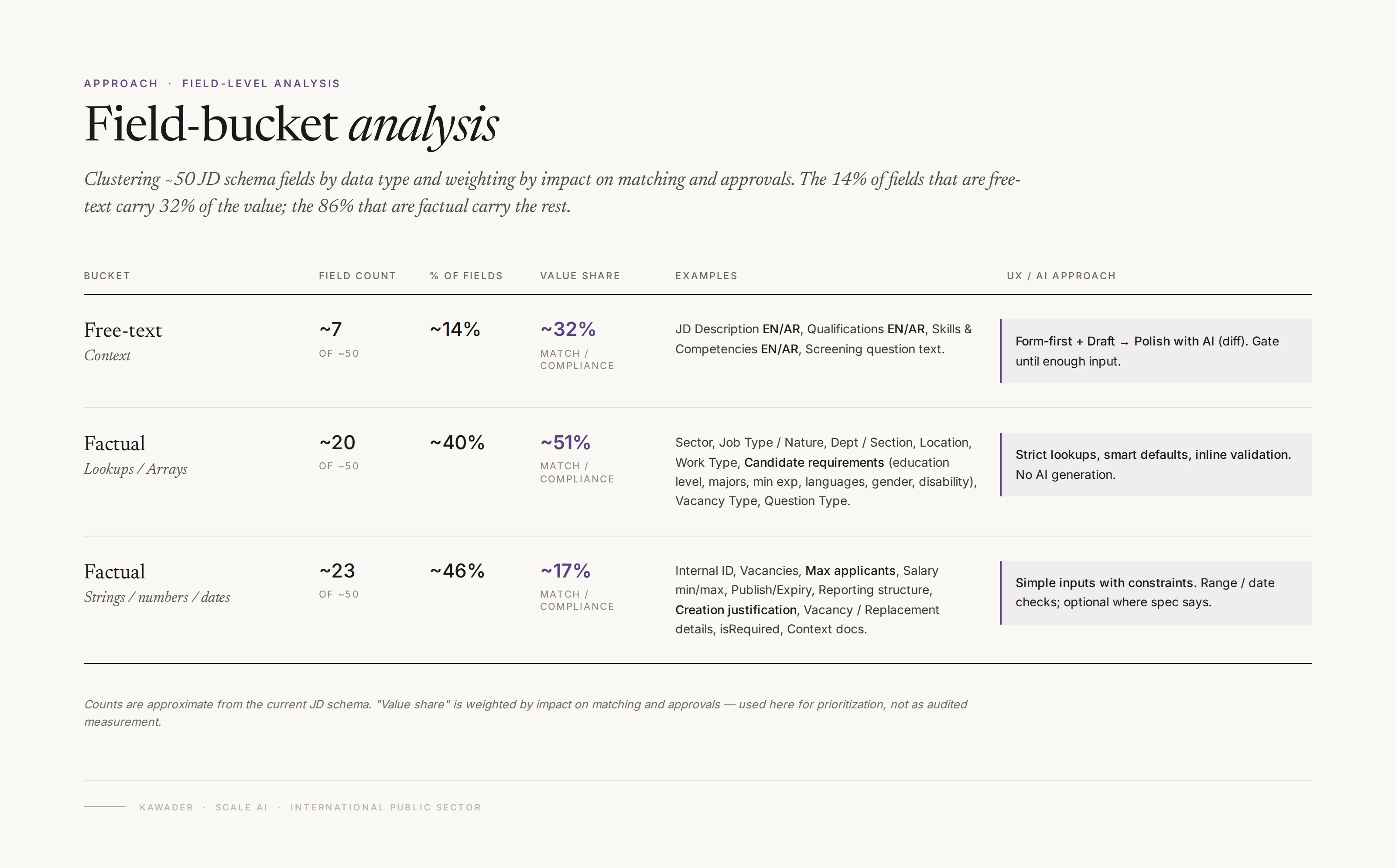
Fields were scored on data structure (lookup vs. free-text), user effort, and decision ambiguity. ~14% were free-text where AI assistance had real lift. ~86% were factual lookups, IDs, dates, or numeric ranges where AI generation added latency without value.
Solution
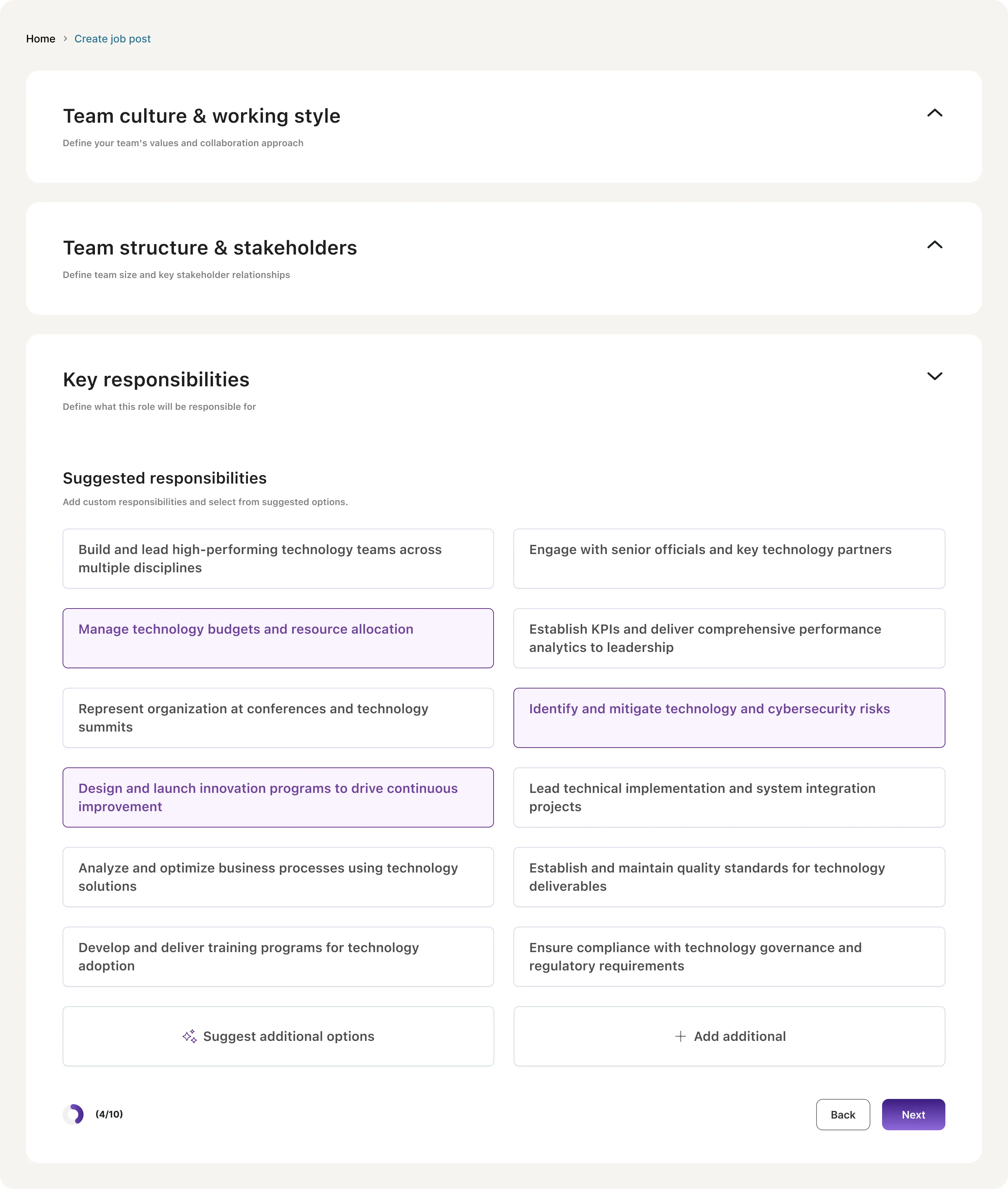
The agentic forms pattern in three moves. No chatbot, no chat shell — forms as the surface, AI doing the structural work alongside.
Parse first. Existing documents pre-populate structured fields. The user starts editing, not entering.
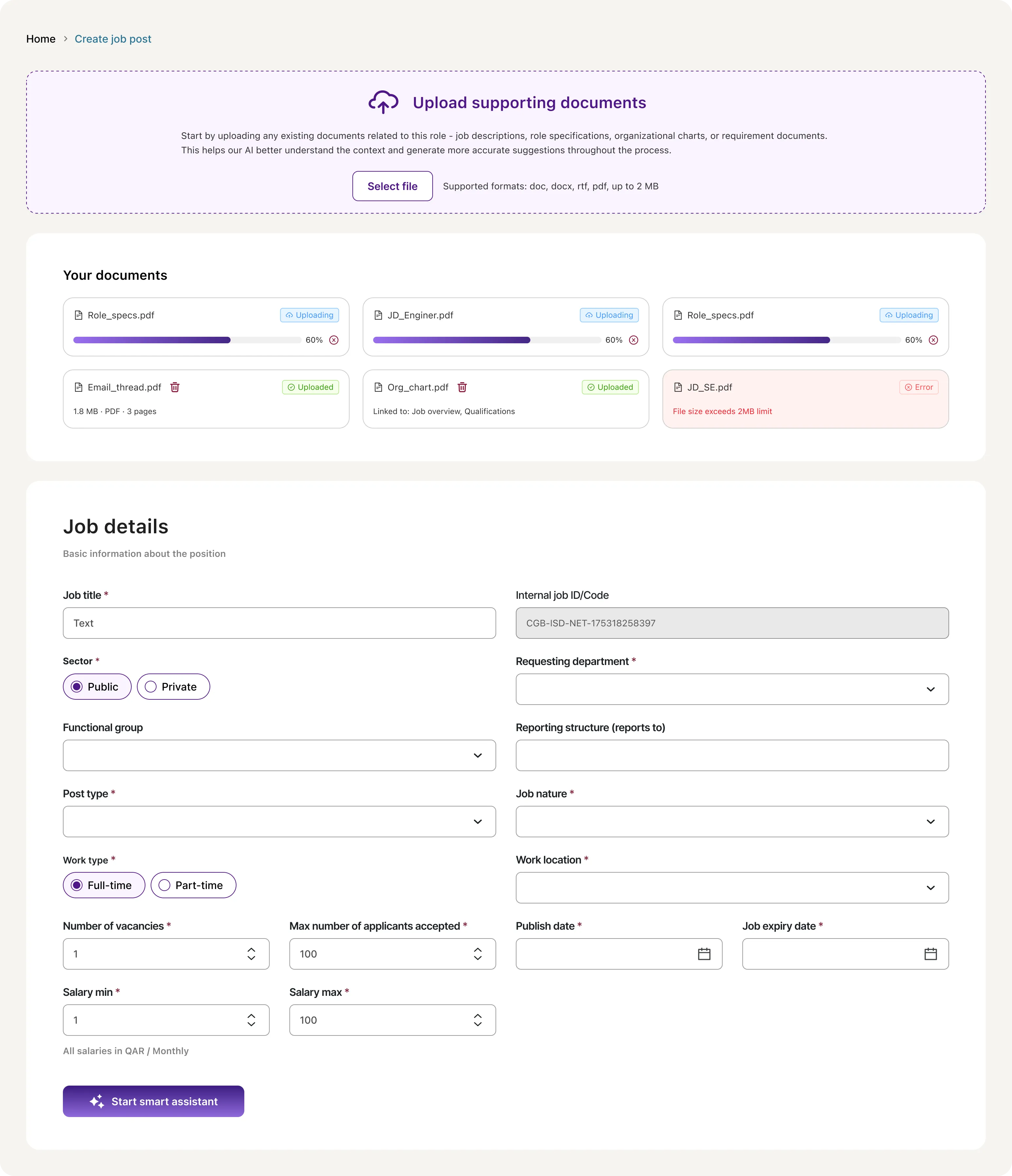
Suggest, don’t generate. AI offers structured options the user selects, deselects, or extends. The form decides what kind of input belongs there; AI populates the menu.
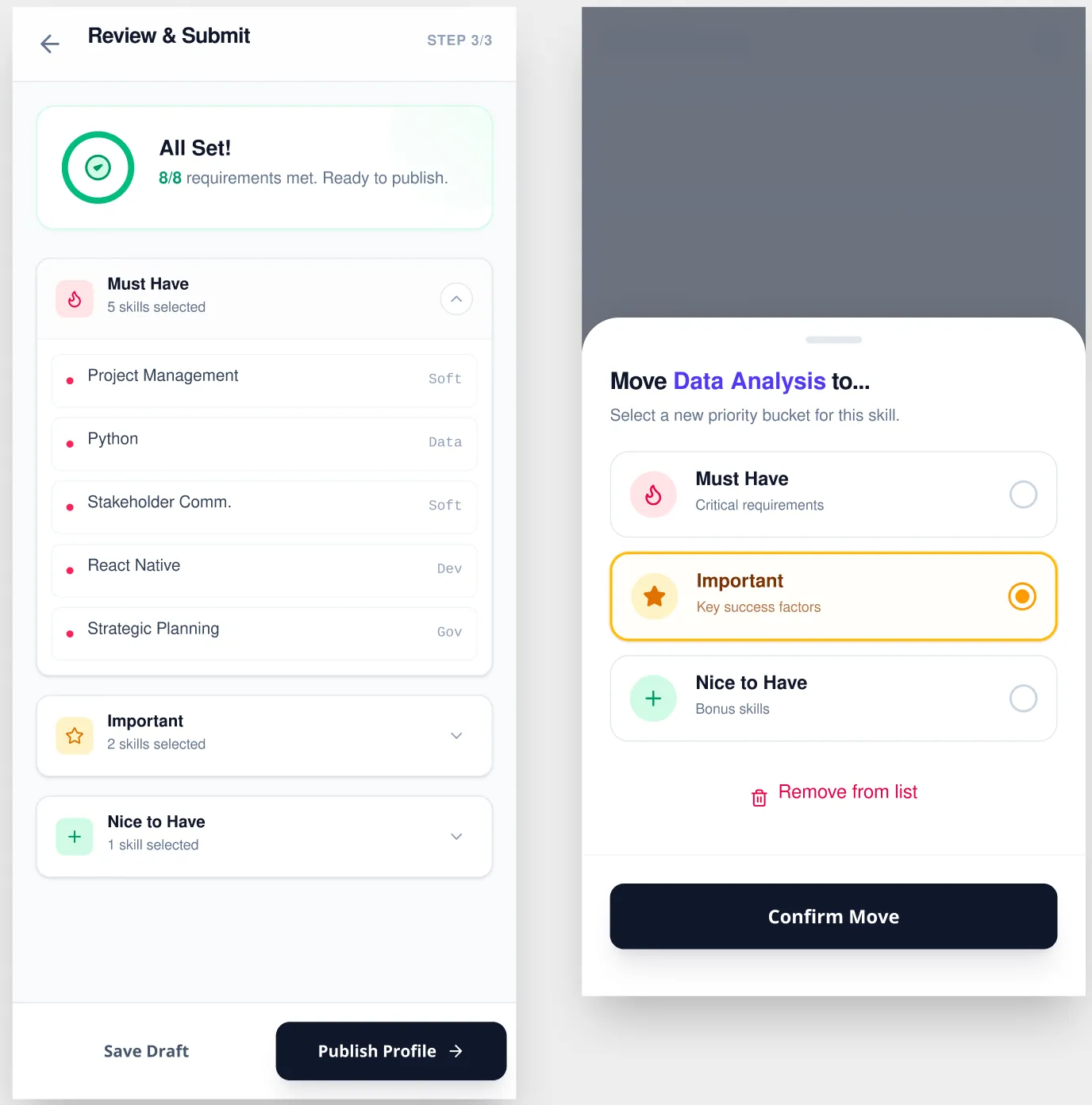
Pre-weight, don’t decide. Where the user has to make ranking or priority calls, AI pre-arranges based on inferred context — role, sector, seniority. The user adjusts. The resulting weights feed downstream matching.
Across the three modules
The pattern landed differently across the three modules, and that’s the honest version of the work.
Profile creation — this was where the pushback started. Profile creation was the first module in development, and the evolution played out here in real time: chat first, then in-chat forms after the first round of research, then a year of accumulated arguments against the chat shell entirely. By the time agentic forms crystallized as a coherent pattern, Profile creation was already in implementation. It was the proving ground, not the place the pattern landed.
Job posting — agentic forms approved by MCIT and CGB and moved to implementation. The structured-data ratio was highest here, which made the field-level argument cleanest.
Matching — different problem. AI was making the most consequential decisions — who gets surfaced for which role — so the surface had to make those decisions adjustable on both sides. For employers, AI-suggested candidates appear alongside open requisitions but stay clearly separable from active applicants and shortlists. For applicants, a smart-matching panel surfaces strategic adjustments — broaden the skills list, expand the company set — that materially change the matches the system returns. AI as advisor on both sides; the user adjudicates.
Outcome
The agentic forms pattern for Job posting was approved by Kawader stakeholders and moved to implementation. Within Scale AI, the PM who named the pattern is writing a white paper documenting agentic forms as a methodology — proposing it as a reusable approach for AI-assisted user input across other International Public Sector engagements.
A note on the pattern, because the distinction matters. On other Scale AI engagements I’ve designed AI-assisted workflows where AI generates content and a human-in-the-loop confirms it — AI as the primary author, the user as reviewer. Kawader’s pattern reverses that. Forms are the surface, the user is the author, and AI sits alongside as guidance — assessing, suggesting, flagging gaps, not generating the content itself. That reversal is what made the pattern portable enough to document.
Reflection
AI is not an interaction model. Chat is one model AI products can use; it’s the default because it’s the lowest-effort one to build. Picking the right pattern is design judgment — and on Kawader Job posting, the right pattern wasn’t chat.
Two reflections worth carrying. An intermediate compromise can be the right answer for one module and the wrong place to stop for another. In-chat forms were the right ending for Profile creation given where it was in implementation; on Job posting, the same compromise would have been a missed opportunity. Pattern decisions are local. And the field-level analysis mattered more than the pattern argument — without it, the case for forms was aesthetic. With it, it was a business case.
Conix →
A GenAI platform for architects, started before anyone was calling it GenAI.